Why Your Last Trading Course Didn't Work (It Probably Wasn't the Strategy)
You paid to learn this once already. If you are still breaking even, the missing piece is rarely a better strategy. It is the risk and review layer most courses skip.

Updated
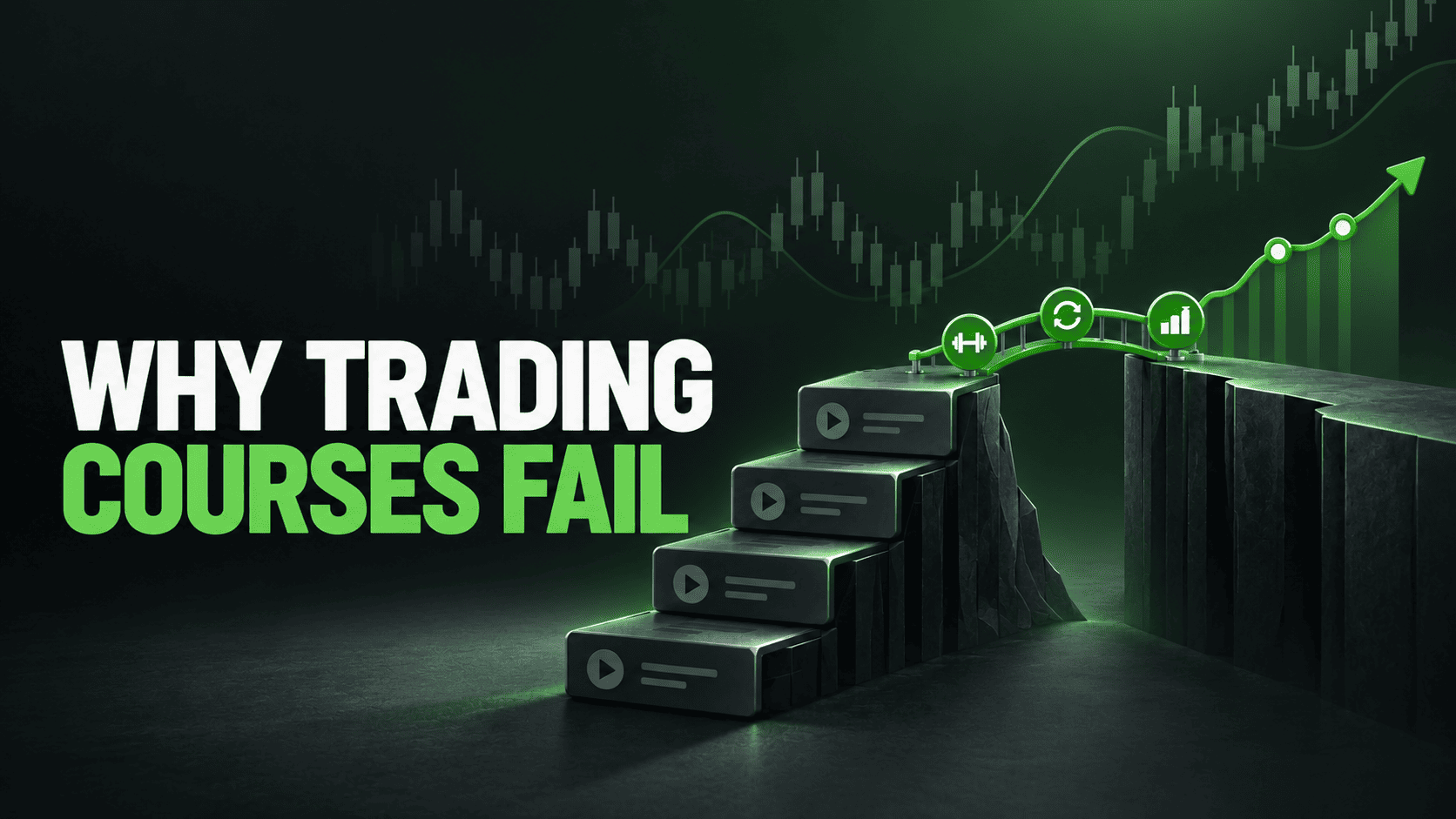
Most trading courses do not fail because the strategy was bad. They fail because they teach tactics, such as setups, indicators and entry rules, without the layer that decides whether an account survives: position sizing, loss boundaries, exposure checks and an honest review of your own decisions. Add a new strategy on top of the same missing layer and you tend to get the same results.
If you are here, there is a good chance you already paid to learn this once. Maybe more than once.
Does this sound like you?
You bought a course. It made sense on the videos. You started trading and, for a while, it worked. Then the market changed, and you found yourself gaining some and losing some, breaking even at best.
One of our members put it exactly like that: "I bought a course, and I started learning futures... then things started changing... there wasn't much profit. I was gaining, and I was losing."
Another came to us after a previous program wanted a $50,000 minimum and would only communicate by email. He paid, and did not get anywhere with them.
So the natural conclusion is that the last course was not good enough, and the answer is a better strategy, a better signal or a bigger name.
Why doesn't a better strategy fix it?
Because the strategy was rarely the bottleneck.
Here is what separates the people who recover from the people who stay stuck, in my experience: the ones who recover close the risk-management and personal-responsibility gap. The ones who stay stuck keep shopping for tactics.
A strategy tells you when to enter. It does not tell you:
- how much to put on, so one loss cannot hurt you (position sizing)
- where the idea is wrong, before you are emotionally invested (invalidation level)
- how this trade interacts with everything else you hold (total exposure)
- whether you actually followed the plan, and what to change (journal and review)
Those four decide your results far more than which indicator you use.
What does a good student look like?
I describe good-student behavior the same way every time. A good student comes to me and says: "Chad, my win rate for the past 30 days was 45%, my profit factor was about 1.2, here are five trades I took, and I want your help to audit them. Am I entering too soon? Is my risk management inconsistent?"
That student will improve, because there is something concrete to work on. Compare it with: "I need help trading." "Can you show me your trades?" "I don't really have any to show you."
Nobody can audit a process that does not exist on paper.
What should you look for before paying for education again?
Run any program, including ours, through this list:
| Look for | Be cautious of |
|---|---|
| Named, verifiable founders | Anonymous "professors" and avatars |
| Live access to people who review your actual trades | Email-only support or recorded content only |
| A curriculum that starts with risk and position sizing | A curriculum that starts with entries and indicators |
| Encouragement to track and share your numbers | Screenshots of wins and nothing else |
| No promised returns or win rates | Income claims, "90% win rate" marketing |
| They tell you to research them first | Pressure to decide quickly |
Getting help that actually helps
The lesson from a course that did not work is not "help does not work." It is that the wrong kind of help does not work. Help that only adds information repeats the old results. Help that looks at your real decisions, with your real numbers, closes the gap.
That is the model inside Crypto Renegades: a curriculum in decision order, the Decision Protocol, and live sessions where members bring their own work to be reviewed. You still make every decision and own every result. You just stop making them alone.
If that sounds like the missing piece, book a fit call. If it is not the right fit, we will tell you that too.
Frequently asked questions
Because many courses teach entries and setups but not the parts that decide survival: how much to risk, where the idea is wrong, how exposures stack up, and how to review decisions honestly. Without those, a good strategy still produces inconsistent results.
It can be, if the program teaches risk management first, gives you live access to people who review your actual decisions, and does not promise returns. Education that only adds more tactics tends to repeat the same results.
Named, verifiable people; live access instead of email-only support; a curriculum that starts with risk; transparency about their own positions and losses; no income guarantees; and encouragement to research them before you join.
General education only, not financial advice. Crypto and leverage involve substantial risk of loss. Read our risk disclosure.

Written by
Chad WittfeldtCo-Founder and Strategy Lead, Crypto Renegades
Chad bought Bitcoin when it traded for a few hundred dollars, went full time on crypto in 2017, added leverage and contracts in 2018 and built a GPU mining warehouse in 2021. He has watched the crypto scam market evolve since before BitConnect.