Holding On for Dear Life Is Not a Plan: What a Bear Market Drawdown Really Costs
Buy and hold asks you to accept a 70% drawdown as the price of believing in the asset. Here is what that costs, and what it looks like to have a plan for both directions.

Updated
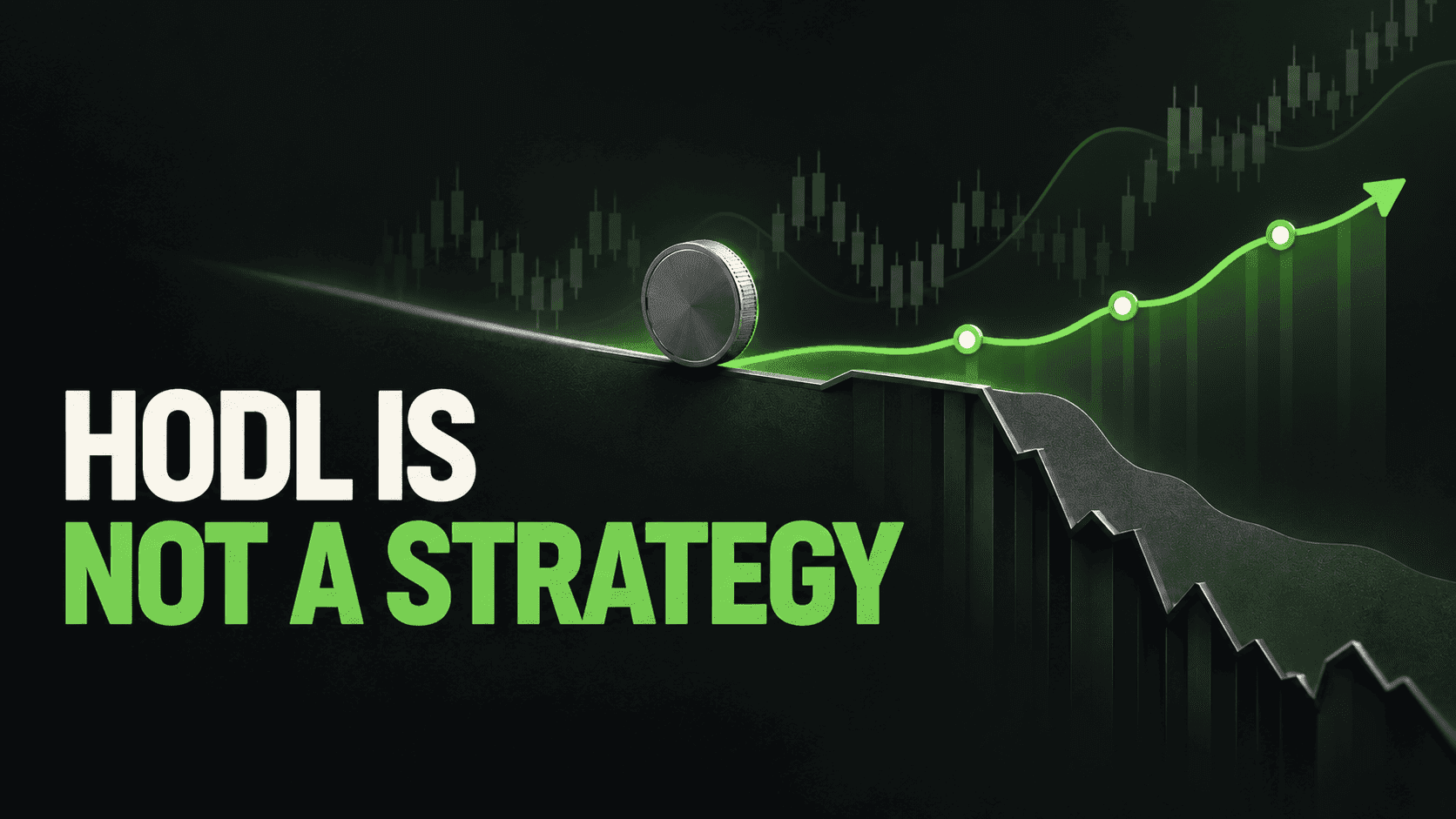
Holding on for dear life means buying a crypto asset and never selling, whatever the price does. It feels disciplined, and sometimes it works. But as a complete plan, it asks you to accept drawdowns of 70% or more as the normal cost of believing in the asset, with no mechanism for anything other than waiting.
In my words, and I have said it on more live calls than I can count: a strategy where you need to hold on for dear life doesn't sound like a very good strategy. If you're just holding on for dear life, you're not in control.
How big are crypto bear market drawdowns?
Bitcoin has gone through several cycles where it fell 70% to 80% or more from its peak before recovering. Many altcoins fell further and never came back. Anyone who has been in crypto for more than one cycle has lived through at least one of these declines.
Believing in the long-term thesis does not make the drawdown smaller. It only means you hold through it.
What does a 70% drawdown actually cost?
The recovery math is brutal, and it is not intuitive.
| Drawdown | $10,000 becomes | Gain needed to get back to $10,000 |
|---|---|---|
| 20% | $8,000 | 25% |
| 50% | $5,000 | 100% |
| 70% | $3,000 | 233% |
| 80% | $2,000 | 400% |
A 70% decline does not need a 70% rally to recover. It needs 233%. That is often years of waiting, and the rally that finally gets you back to even is the one where everyone else is buying.
There are costs beyond the number, too. Months of checking the price with no plan. Opportunities you cannot take because your capital is frozen in a position you are afraid to touch. The quiet regret of having no answer to "what is your exit?"
Why does bought-near-the-top feel so paralyzing?
Most people who hold through a crash did not plan to. They bought when the move was obvious and the headlines were loud, near the top, and then the market turned. One of our members described it exactly: he got in right around when Bitcoin hit its all-time high, and before you know it, it falls out on you.
The instinct is to blame the entry price. "I just got unlucky with timing." But the entry was never the real problem. The problem was having no plan for either direction: no invalidation level, no drawdown limit, no way to act when the thesis stopped working. So doing nothing gets relabeled as patience.
What does a two-sided plan look like?
A sailor who can only sail with the wind at their back is at the mercy of the weather. A sailor who knows how to tack makes progress whichever way it blows.
In markets, tacking is bidirectional exposure: being able to take positions in both directions with defined risk. In practice that can mean:
- Keeping long-term holdings, if you believe in them, as a defined part of the allocation rather than the whole of it.
- Hedging during downturns with short positions sized so that a falling market reduces the portfolio's losses rather than multiplying them.
- Taking active positions in either direction when a written thesis supports it, each with its own stop loss and position size.
Picture two farmers planting the same field. One plants only crops that need rain and prays for a wet year. The other plants a mix, some that thrive in rain and some in drought. Same field, same weather, very different harvest.
Isn't shorting and leverage just gambling?
Used without rules, yes. Shorting and leveraged contracts can lose money quickly, and liquidation can arrive faster than people expect. That risk is real, and anyone who tells you otherwise is selling something.
The distinction is between undisciplined leverage and leverage used inside a risk framework. With a written thesis, a loss boundary set before entry, a position size built from that boundary, and a stop placed well before the liquidation price, a short position is a tool with a defined worst case. Without those, it is a bet.
That is why bidirectional exposure comes after risk management in everything we teach, never before.
Where to start if you are holding a bag right now
- Write down your thesis for the position. Why do you still hold it? What would prove that reason wrong?
- Decide your worst case. At what price, or what portfolio drawdown, would you act instead of wait?
- Check your total exposure. How much of your net worth is in positions that all move together?
- Learn the other side before you use it. Study how short positions and hedges work, with small size or on paper, before real capital is involved.
None of this requires selling your long-term conviction. It requires having a plan that does not depend on the market doing what you hope.
If you want to learn the full process, including how members plan for both directions, book a fit call. If it is not a fit, we will say so.
Frequently asked questions
Holding long-term positions can be a valid part of an allocation. The problem is treating it as the entire plan: no exit criteria, no drawdown limit and no way to benefit when the market falls. That leaves you entirely dependent on the market cooperating.
A 233% gain. After a 70% loss, $10,000 becomes $3,000, and $3,000 has to more than triple to get back to $10,000. The deeper the drawdown, the harder the recovery math becomes.
It means being able to take positions in both directions of the market, long and short, with defined risk. It turns a falling market from something you sit through into a condition you can plan for. It carries real risk and belongs after position sizing and loss boundaries are in place.
General education only, not financial advice. Crypto and leverage involve substantial risk of loss. Read our risk disclosure.

Written by
Chad WittfeldtCo-Founder and Strategy Lead, Crypto Renegades
Chad bought Bitcoin when it traded for a few hundred dollars, went full time on crypto in 2017, added leverage and contracts in 2018 and built a GPU mining warehouse in 2021. He has watched the crypto scam market evolve since before BitConnect.